COCONINO SUN
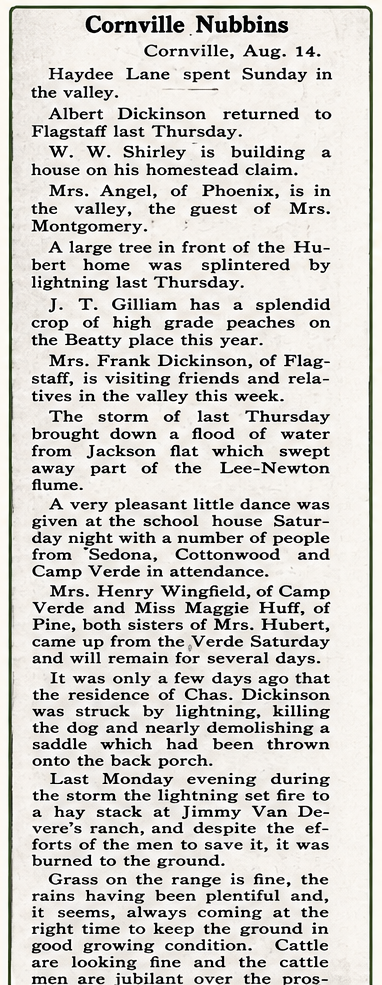
CORNVILLE NUBBINS
AUG 19, 1910
Sometimes a family's history is found in only a few lines of an old newspaper.
On Friday, August 19, 1910, The Coconino Sun of Flagstaff published its regular news coverage of northern Arizona. On page eight was a short column titled “Cornville Nubbins,” dated August 14. The column reported the everyday happenings around Cornville and the Verde Valley—visitors coming and going, a schoolhouse dance, storm damage, crops, cattle, and other local news.
View the full newspaper page containing this article
The Coconino Sun was a Flagstaff newspaper, not a Cornville newspaper. Its roots went back to Artemis E. Fay's Arizona Champion, which Fay moved from Peach Springs to Flagstaff in 1884. The newspaper eventually became The Coconino Sun and was later succeeded by today's Arizona Daily Sun. The Arizona Memory Project describes The Coconino Sun as the dominant publication in Flagstaff and notes that it covered news across the vast expanse of northern Arizona.
That makes the brief Cornville column particularly valuable. Although only a small portion of the newspaper, it provides a glimpse into life in the Verde Valley as reported by one of northern Arizona's principal newspapers.
And tucked into those few paragraphs are three references to the Dickinson family.
Three Dickinsons in One Column
The first mention reads:
“Albert Dickinson returned to Flagstaff last Thursday.”
A few paragraphs later, the newspaper reported:
“Mrs. Frank Dickinson, of Flagstaff, is visiting friends and relatives in the valley this week.”
Then came a more dramatic item:
“It was only a few days ago that the residence of Chas. Dickinson was struck by lightning, killing the dog and nearly demolishing a saddle which had been thrown onto the back porch.”
At first, these might appear to be three unrelated newspaper mentions.
They were not.
The three references connect members of the same Dickinson family.
Mrs. Frank Dickinson was Hulda Susan (Smith) Dickinson, wife of Frank Lee Dickinson.
Alfred “Alf” Dickinson was Frank's brother, making him Hulda's brother-in-law.
Charles Dickinson was the half-brother of both Frank and Alfred.
The Dickinson family records identify Charles as the son of Samuel Cotton Dickinson and Adline Green Dickinson. Charles's half-siblings included Frank Lee Dickinson and Alfred “Alf” Dickinson, children of Samuel Cotton Dickinson and his second wife, Nancy Jane Green.
Thus, the three Dickinson references in this little Cornville column connect Charles, Frank, Alfred, and Hulda—four people whose lives were tied together through the Dickinson family.
The “Albert” Dickinson Mystery
There is an intriguing detail in the first newspaper reference.
The Cornville Nubbins column clearly says:
“Albert Dickinson returned to Flagstaff last Thursday.”
But the Dickinson family records identify Frank's brother as Alfred “Alf” Dickinson, born July 21, 1870. Alfred was a rancher and hotel owner and was associated with both Flagstaff and the Verde Valley. His family record lists Frank Lee Dickinson as his brother and Charles Dickinson as his half-brother.
There is also an important clue on the very same newspaper page.
In the Stock Brands section on the right side of page eight is a listing for:
“Alf Dickinson — Sedona, Arizona.”
The listing includes his cattle brand and identifies his range as the Rock Top and Woods ranch area.
This creates a compelling connection.
The newspaper's Cornville column refers to “Albert Dickinson.” The same page identifies “Alf Dickinson.” Family records identify Alfred “Alf” Dickinson as Frank's brother.
The evidence strongly suggests that the “Albert Dickinson” mentioned in the Cornville column was actually Alfred “Alf” Dickinson.
However, the original newspaper should be preserved exactly as printed. Rather than silently changing “Albert” to “Alfred,” the discrepancy itself becomes part of the historical record.
This is a good example of why historical research requires comparing multiple sources rather than automatically assuming that every newspaper entry is correct.
Charles Dickinson in 1910
The third Dickinson reference provides an especially vivid glimpse of everyday life.
The newspaper reported that lightning had struck Charles Dickinson's residence, killing the dog and nearly demolishing a saddle that had been thrown onto the back porch.
Charles Dickinson was not simply another name in the newspaper.
He was one of the early settlers of the Verde Valley.
Charles was born in August 1853 in Van Buren County, Iowa. In 1875, he traveled west with the Dickinson family wagon train from Humansville, Missouri. The wagon train reached the Verde Valley on August 23, 1875, after a journey of more than three months. The family eventually settled around Oak Creek and operated the first post office at Cornville. Charles later worked as a stage driver and carpenter and became an established member of the Verde Valley community.
By 1910, Charles had been in Arizona for approximately thirty-five years.
The brief newspaper report about the lightning strike therefore gives us something that a genealogy chart cannot.
It tells us about an actual day in his life.
We can picture the scene: a summer storm moves across the Verde Valley, lightning strikes the Dickinson residence, the family dog is killed, and a saddle lying on the back porch is nearly destroyed.
It is a tiny event in the history of the Verde Valley.
But more than a century later, it helps bring Charles Dickinson back to life as a person rather than simply a name and a set of dates.
A Family Passing Through the Valley
The newspaper also tells us that Hulda, the wife of Frank Dickinson, was visiting friends and relatives in the valley.
That simple sentence is worth noticing.
By 1910, the Dickinson family had been connected to the Verde Valley for decades, yet members of the family were still traveling between communities such as Flagstaff, Sedona, and the Verde Valley.
The newspaper captured one of those ordinary moments.
Alfred was returning to Flagstaff.
Hulda was visiting friends and relatives.
Charles was dealing with the aftermath of a lightning strike.
None of these events would normally be considered major history.
Yet this is precisely the kind of information that makes historical research so rewarding.
Why These Old Newspaper Columns Matter
Genealogical records give us relationships, dates, marriages, births, deaths, and places.
Newspapers often give us something different.
They give us life.
A short local-news column can tell us that someone traveled to town, visited relatives, attended a dance, suffered a storm, lost an animal, built a house, harvested peaches, or returned home.
These details were ordinary to the people who read the newspaper in 1910.
Today, they are historical evidence.
The August 19, 1910 issue of The Coconino Sun provides exactly that kind of evidence. On a single page, the newspaper connects Charles Dickinson, Frank Lee Dickinson, Alfred “Alf” Dickinson, and Hulda (Smith) Dickinson while also giving us a glimpse of the communities in which they lived.
And the page contains one more remarkable connection: the same issue that reported “Albert Dickinson” in the Cornville news column also carried Alf Dickinson's cattle brand in its Stock Brands section.
One newspaper page.
Three Dickinson men.
One Dickinson family.
And a few ordinary events that survived for more than a century.
That is the value of preserving the small pieces of history.
Sources
The Coconino Sun, Flagstaff, Arizona, Friday, August 19, 1910, page 8. “Cornville Nubbins,” dated August 14, 1910. The page also contains the Stock Brands listing for “Alf Dickinson.”
Charles Dickinson, 1853–1926, Dickinson Family Research. (Dickinson Family Genealogy)
Alfred “Alf” Dickinson, 1870–1940, Dickinson Family Research. (Dickinson Family Genealogy)
Frank Lee Dickinson, 1867–1925, Find a Grave Memorial 81270157.
The Coconino Sun historical background, Arizona Memory Project and Library of Congress. (AZ Memory)